Understanding Spring and Fall Freeze Probabilities for Planting
A warm afternoon can make a Virginia garden feel ready for planting, while one cold night can put tender seedlings at risk. Freeze probabilities help you judge that uncertainty without treating a calendar date as a promise. This guide explains what spring and fall probabilities mean, how to apply them to different crops and regions, and when protection can help.
What a Freeze Probability Tells You
A freeze probability describes the likelihood of a specified low temperature occurring by or after a date, based on weather records for a location. It is a measure of risk, not a prediction for a particular night. A spring date with a lower chance of a later freeze is generally a more cautious benchmark for tender plants than one with a higher chance.
The key is to check what the probability in a table actually refers to. A spring table may show the chance that a freeze will occur after a date, or it may show the chance that a freeze has occurred by a date. Those are opposite ways of describing the same seasonal pattern. Read the table notes before using a date to plan a planting.
A probability date is also not a deadline. A late freeze can happen after a date that has passed in most years, and a mild stretch can arrive before a conservative date. The probability helps you decide how much risk you are willing to accept, especially when the crop is vulnerable and replacement would be difficult.
The seasonal meaning of a spring date
In spring, gardeners are usually asking: “How likely is it that freezing weather will still occur after I plant?” A date associated with a relatively high chance of a later freeze is a cautious reference point. A date associated with a relatively low chance of a later freeze suggests that the risk has declined, but it has not disappeared.
For example, a gardener planting cold-tolerant greens may accept more remaining risk than someone setting out a tray of tender tomato seedlings. Neither decision changes the weather probability. The difference is how much damage each gardener is prepared to tolerate and whether protection or replacement is practical.
For fall, the question reverses: “How likely is a freeze to arrive by a certain point?” A probability table can help estimate how much time remains for an outdoor crop to mature. It cannot guarantee the date of the first freeze or tell you the exact night when a particular yard will become cold.
Median dates are not guarantees
A date at the middle of a probability distribution is a useful reference, but it does not mean that freezing weather is unlikely on either side of it. In a simplified interpretation, a 50% spring date represents a midpoint in the historical pattern: the final freeze happened later in some years and earlier in others. The precise wording and calculation vary by source, so use the table’s own definition.
That makes a median date a poor choice if even one freeze would cause a major loss. It can be a reasonable planning marker for a gardener who is willing to protect plants, replace them, or accept some damage. A more cautious date can reduce exposure to late freezes, but it also means waiting longer and potentially giving warm-season crops less time to grow.
Probability depends on the temperature threshold
“Freeze” is not always used to mean the same temperature in different gardening resources. A table may be based on a temperature at or below 32°F, while another resource may show a different threshold. Frost and plant injury do not always line up perfectly with an official air-temperature reading.
Many gardening references use 28°F as a hard-freeze benchmark, but duration, wind, humidity, plant condition, and site exposure affect the damage. Frost can form on surfaces when the reported air temperature is above 32°F, particularly on clear, calm nights when exposed plant tissues lose heat. Conversely, a brief dip to a low temperature may not damage every plant equally.
When comparing dates from two sources, check that they use the same temperature threshold and the same probability definition. A date based on a 32°F freeze is not directly interchangeable with one based on a lower temperature. For more on how local freeze dates are found, see Looking Up Spring and Fall Freeze Dates for Virginia Stations.
How to Read and Use Freeze-Date Information
A useful freeze-date table tells you at least three things: the location or weather station, the temperature threshold, and what its probability means. If any of those details are missing, the date is hard to apply responsibly. One station’s history can provide a useful starting point, but it does not describe every backyard in its surrounding area.
Weather stations collect observations at particular locations. Their records support probability estimates, but the station is not a perfect stand-in for a home garden. The estimate reflects a historical pattern under the station’s measurement conditions. It does not account for every slope, wall, tree canopy, pavement, or hollow that can shape a garden’s nighttime temperature.
Match the station to the garden as closely as practical
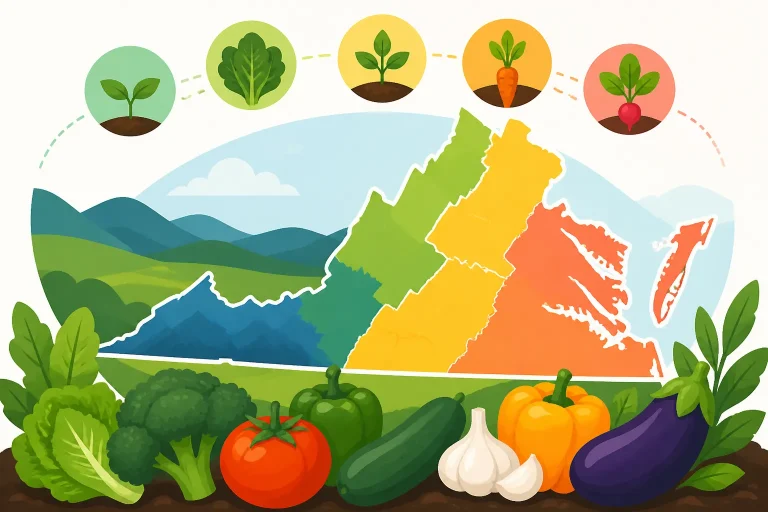
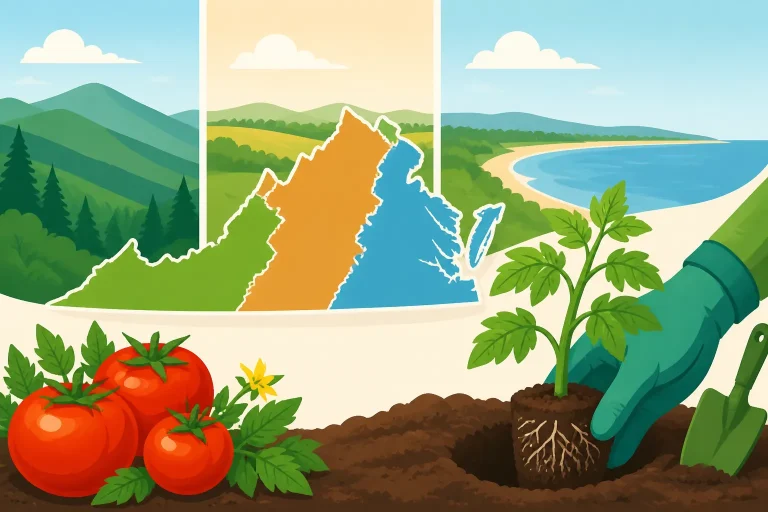
Start with a station in or near the same broad region as the garden. In Virginia, the Coastal Plain and Tidewater, Piedmont, Shenandoah Valley, and mountain areas can have different seasonal patterns. Even within one region, elevation and local terrain can make meaningful differences.
If a nearby station is at a different elevation or sits in a different landscape, its dates may be a less useful match than a somewhat farther station with similar conditions. Do not assume that a town’s weather station represents all surrounding neighborhoods. Use the station as a reference, then consider how the garden’s site differs.
For a more detailed look at local effects, see How Virginia Elevation and Microclimates Shift Frost Dates and Microclimates and Growing Windows Across Northern Virginia. The same ideas apply beyond Northern Virginia: a garden’s immediate surroundings can make its conditions earlier, later, colder, or warmer than a regional average suggests.
Check the table’s labels and limitations
Before using a probability date, confirm:
- The temperature threshold: Is the date based on 32°F, a lower temperature, or another measure?
- The probability direction: Does the percentage describe the chance a freeze will occur after the spring date, or the chance it has already occurred by then?
- The season: Is it a last-freeze estimate for spring or a first-freeze estimate for fall?
- The location: Which station or area does the estimate represent?
- The period of record: What years of observations were used?
- The date format: Does the table show a calendar date, a range, or a probability curve?
A table can be mathematically useful and still be a rough fit for your garden. Historical estimates describe patterns in the records used to create them; they do not promise that future weather will follow the same pattern. As a result, the sensible use of a probability is to compare risk levels, not to pick a date and stop watching the forecast.
Use a range of risk, not one magic date
It is often helpful to think in terms of a planting window. A cautious window reduces exposure to late cold but can delay planting. An earlier window gives the crop more time in the ground but accepts more risk. The right balance depends on crop sensitivity, how quickly it can recover, whether you can protect it, and what a failed planting would cost in time and effort.
Virginia’s regional differences matter here. A planting calendar can help translate broad seasonal patterns into crop-specific decisions. See Virginia Vegetable Planting Calendar by Region for a regional overview, or Understanding Spring and Fall Freeze Probabilities for Planting is the topic of this article, so do not link to itself. For a broader seasonal view, use Virginia Three-Season Crop Calendar: Spring Through Fall and Virginia Frost and Freeze Date Guide for Gardeners.
Spring Planting: Match the Risk to the Crop
A probability date is more useful when paired with a crop’s tolerance for cold. Some plants can grow through cool weather and may tolerate a light frost. Others can be injured by chilling temperatures or killed by a freeze. Even among crops in the same category, seedlings, established plants, and plants recently moved outdoors may respond differently.
The practical question is not simply “Has the last freeze date passed?” It is “What is the likely harm if a freeze occurs, and what can I do about it?” A gardener may sow peas or cold-tolerant greens while there is still some freeze risk, then wait to set out tender transplants. This spreads risk across different crops instead of making the entire garden depend on one date.
Cool-season crops can use an earlier window
Peas and many leafy greens are suited to cool conditions. Their planting windows can begin before the risk of freezing has fully passed, though germination and growth still depend on soil and weather conditions. Cold tolerance does not mean unlimited tolerance: newly emerged seedlings, prolonged cold, saturated ground, and sharp temperature swings can all affect establishment.
For early sowing, pay attention to the soil as well as the air. Wet, cold soil can be difficult to work and can slow seedling growth. A probability date cannot tell you whether a bed is dry enough to prepare or warm enough for a particular seed to germinate. If the ground is cold and muddy, waiting for workable conditions may be a better choice even when the crop can withstand a light frost.
See Direct-Sowing Peas and Cold-Hardy Greens in Early Virginia Spring for crop-specific timing considerations. For a wider comparison of sowing and transplanting methods, Virginia Seed Starting: Direct Sowing vs Indoors can help you choose how to establish a crop while managing the outdoor risk.
Warm-season crops need more than a frost-free forecast
Tomatoes, peppers, eggplant, cucumbers, squash, and other warm-season crops are vulnerable to cold. Passing a spring probability date does not automatically mean conditions are good for them. A plant can avoid frost injury and still be stressed by cold air or cold soil, which can slow establishment and delay growth.
For warm-season crops, use several checks together:
- Freeze risk: Is the remaining risk acceptable for this crop and your ability to protect it?
- Night temperatures: Are upcoming nights likely to be cold enough to stress tender plants?
- Soil warmth: Is the planting bed warm enough for roots and, where relevant, direct-sown seeds?
- Plant readiness: Are transplants sturdy and properly hardened off?
- Forecast: Is a cold front or unusually chilly stretch expected soon?
Tomatoes are a common example of why a single calendar date is not enough. A forecast without freezing temperatures may still include nights that slow seedlings or make newly planted tomatoes struggle. For regional details, see When to Plant Tomatoes in Virginia by Region and Elevation and Safe Spring Soil Warmth for Setting Out Virginia Tomatoes.
Seedlings have their own vulnerabilities
Indoor-grown seedlings often need gradual adjustment to outdoor conditions before transplanting. A plant that grew under steady indoor light and temperatures may be more vulnerable to wind, full sun, and cold than an established outdoor plant. Hardening off helps the plant adjust, but it does not make a tender crop frost-proof.
If seedlings are ready before conditions are suitable, keep them protected rather than setting them out solely because a probability date has passed. Avoid rushing indoor seed starting so far ahead that seedlings become overgrown while outdoor conditions remain unsuitable. Hardening Off Vegetable Seedlings for Virginia Garden Beds covers the transition to outdoor conditions, and How Many Weeks Before Last Frost to Start Summer Seeds Indoors can help with timing the indoor phase.
Decide in advance how much risk you will accept
A useful planting plan includes a fallback. If the forecast turns cold, will you cover the crop, move containers, delay planting, or accept some loss? How much time would it take to replace seedlings? A small home garden may make an early planting worthwhile because the gardener can cover a few rows. A larger planting may call for a more cautious schedule.
The table below gives a general way to think about the trade-offs. It does not replace crop-specific information or a local forecast.
| Planting approach | Main advantage | Main trade-off | Often suits |
|---|---|---|---|
| Cautious, lower-risk timing | Less exposure to a late freeze | Delays planting and may shorten the growing period | Tender transplants or crops that are hard to replace |
| Middle-ground timing | Balances a useful growing window with some caution | A late freeze remains possible | Gardeners willing to monitor forecasts and protect plants |
| Early, higher-risk timing | Gives the crop more time if weather cooperates | Greater chance of cold injury or replanting | Cold-tolerant crops or gardeners prepared to protect them |
Fall Planting: Work Backward from the First Freeze
Fall planning starts with a different problem. Instead of waiting for the final spring freeze, you need to estimate how much growing time remains before cold weather limits the crop. A first-freeze probability can help you choose a sowing or transplanting window, but it is only one part of the calculation.
A crop may keep growing after a light frost, while another may be damaged before an official freeze occurs. Daylight also declines through fall, and cooler weather slows development. That means a plant can need more calendar time to mature in autumn than the seed packet’s days-to-maturity estimate suggests.
Allow time for both maturity and establishment
For a fall crop, consider the time needed to germinate, grow, and reach a harvestable stage. If starting transplants, include the period they need to establish after going into the bed. Then allow a buffer for slower autumn growth and variable weather.
Seed-packet days to maturity are useful for comparisons, but they are not an exact harvest promise. The stated figure may be measured from sowing or transplanting, depending on the crop and the producer. Shortening days, cold soil, heat during germination, and a late planting can all shift the actual harvest. See Adjusting Days to Maturity for Short Autumn Days in Virginia and Matching Days to Maturity to Fall Virginia Frost Dates.
Fall planting also has a different balance of risk than spring planting. A crop started too early may face intense summer heat, dry seedbeds, or difficult germination. Started too late, it may not size up before cold weather and short days slow growth. Aim for a window that gives the crop a realistic chance to develop, rather than treating the first-freeze date as the only cutoff.
Choose crops by their cold tolerance and harvest goal
Cold-tolerant crops can often remain in the garden after more tender plants have finished. Their ability to withstand cool weather can extend the harvest, but tolerance varies by crop, variety, growth stage, and the severity and duration of cold. A forecasted freeze may still require action even when a crop is described as hardy.
Decide what you want from the fall planting. Are you aiming for quick leafy growth, roots to harvest before deep cold, or plants that will continue producing through a cool period? Those goals require different amounts of lead time. A crop grown for mature roots may need a longer establishment window than one harvested as young leaves.
For Virginia-specific planning, Planning Fall Crops with the Virginia Vegetable Calendar and Fall Garden Sowing Windows and Cool-Season Crop Timing can help organize crop choices and sowing windows. If you are choosing between several crops, compare their growth time and frost response instead of assuming all cool-season vegetables can be planted together.
Expect the fall window to vary across Virginia
A fall freeze does not arrive on a uniform schedule statewide. Coastal and Tidewater gardens, the Piedmont, valleys, and higher mountain locations can have different patterns. Elevation, slope position, and cold-air drainage may make one garden vulnerable earlier than a nearby exposed site.
This is one reason a state-level calendar should be treated as a starting point rather than a yard-specific forecast. Use regional guidance first, then refine it with station information and local observation. Virginia Vegetable Planting Windows by Hardiness Zone can help with crop timing, while How Virginia Elevation and Microclimates Shift Frost Dates explains why nearby sites may differ.
Microclimates, Forecasts, and the Garden Itself
Freeze probability describes an area’s historical pattern, but a garden has its own nighttime conditions. A low spot may collect cold air. A slope can drain cold air more effectively, while a wall or paved surface may release stored heat after sunset. Tree cover can reduce radiational cooling in some situations, though it may also shade the growing area and change its daytime warmth.
These effects can make a planting bed behave differently from the nearest weather station. They do not erase regional risk; they help explain why a garden may regularly experience frost earlier or later than a nearby report suggests.
Cold air moves and pools
On clear, calm nights, surfaces lose heat and the air close to the ground can become colder than the air measured higher above it. Cold air also tends to move downhill and collect in low areas. A garden at the bottom of a slope or in a sheltered hollow may be more exposed to frost than one on a gentle slope with room for air to drain.
Observe where frost appears first in your yard. Note whether it forms in low spots, near open lawn, beside a fence, or under particular trees. Those patterns can help you decide where to place the most sensitive crops. A warm corner beside the house may extend a planting window, but it should not be treated as protection against every freeze.
Local protection changes the consequences, not the probability
Covers, cold frames, and other barriers can reduce exposure, but they do not change the probability date for the weather station. Their effectiveness depends on the material, how it is installed, the cold’s severity and duration, and whether the cover is removed or opened when conditions warm. A cover that rests directly on leaves may offer less protection than one that leaves space around the plants, depending on the setup.
Row covers can help manage light frost risk and may also be useful for other purposes during the growing season. They are not a guarantee against a severe or prolonged freeze. Read Using Row Covers for Light Frost Defense and Midday Heat Screening and Extending Virginia Growing Seasons With Covers and Cold Frames for practical considerations on protective structures.
Protection requires attention. Covers can trap heat on sunny days, and some materials may need support to keep them from pressing on plants. If you use a product or structure, follow its instructions and check conditions beneath it rather than assuming the garden is safe because it is covered.
Watch the forecast as planting approaches
Probability tables help with planning weeks or months ahead. Short-range forecasts help with decisions for the next few nights. As a planting window approaches, use both: the probability establishes the broader seasonal risk, while the forecast shows whether a particular cold spell is expected.
Forecasts can change, and a forecasted low is not necessarily identical to the temperature at plant height in your garden. Keep vulnerable crops in a position where you can protect or move them if a cold night becomes likely. Check again as the event gets closer, especially when the forecast is near freezing or the garden is known to be a frost pocket.
A forecast can also help you avoid unnecessary delays. If a brief cold spell is expected but the planting is not urgent, waiting a few days may be simpler than covering a large bed. If the crop is cold-tolerant or already established, you may choose to leave it in place. There is no single response that fits every crop or garden.
Build a Planting Plan Around Risk, Not a Fixed Date
A practical calendar combines probability information, crop needs, local conditions, and a willingness to respond to changing weather. That approach works better than following one date for every vegetable. It also makes it easier to adjust when spring comes early, fall stays mild, or a cold snap arrives at an inconvenient time.
Use a simple decision process
- Identify the crop and growth stage. A newly emerged seedling, an indoor transplant, and an established plant may have different vulnerabilities.
- Find a relevant local probability estimate. Check the station, threshold, probability definition, and historical period.
- Decide how much risk is acceptable. Consider whether a freeze would set the crop back, kill it, or merely interrupt growth.
- Check conditions beyond the date. In spring, consider soil warmth and night temperatures. In fall, consider maturity time, declining daylight, and how much cold the crop can tolerate.
- Look at the forecast as planting approaches. Use current forecasts to respond to specific cold risks, not to replace long-range planning.
- Choose a response before planting. Decide whether to delay, protect, move containers, or accept the possibility of replanting.
- Keep notes. Record where frost occurs in the garden and how crops respond. Over time, those observations can help refine the regional guidance.
This process does not remove uncertainty. It makes the uncertainty visible, which is often enough to prevent a rushed decision based on one warm day or a date taken out of context.
Keep separate plans for different crops
A garden can have several planting windows at once. Cold-tolerant crops may be sown while tender crops remain protected indoors. Warm-season crops can wait for suitable soil and nighttime conditions, even after the risk of a hard freeze has become low. Fall greens may be started while summer crops are still producing, then take over beds as those plants finish.
Planning in stages makes the garden less dependent on one date. It can also reduce the amount of space that needs protection at any one time. For help planning repeated plantings, see Planning Multi-Crop Successions Across Virginia Beds and Succession Planting: Moving from Summer Vegetables to Fall Crops.
The calendar should also reflect the work you can realistically do. If you cannot cover plants during a cold snap, a later, more cautious planting may be the better fit. If you can move containers indoors and protect a small bed, an earlier attempt may be worthwhile. The best schedule is the one that matches both the crop and the gardener’s capacity to respond.
Record what happens in your own beds
A short garden record can improve future decisions. Note the approximate date of a frost or freeze, the bed where it occurred, the crop’s growth stage, and any damage. Record whether a nearby wall, slope, or cover seemed to affect the outcome. These observations do not replace station records, but they give those records local context.
Avoid turning one unusual season into a permanent rule. A warm spring does not prove that an early planting is safe every year, and a late freeze does not mean a probability estimate is useless. The value of a record comes from comparing observations over multiple seasons and treating them as another source of evidence.
When you review the notes, look for patterns: which part of the yard freezes first, which crops tolerate brief cold, and which planting decisions led to good or poor establishment. Then adjust the next season’s plan. A probability date provides a broad risk estimate; repeated observation helps you use it more intelligently in a particular garden.
Frequently Asked Questions
Does passing the spring freeze date mean it is safe to plant everything?
No. A probability date does not guarantee that freezing weather is over. Tender crops can also be stressed by cold conditions above freezing, and cold soil can slow growth. Match the timing to the crop and check the forecast.
Is a 50% freeze date a safe planting date?
Not necessarily. A 50% date is a midpoint in the historical pattern under the table’s definition. It does not mean the risk is negligible. It may suit a gardener who accepts risk and has a plan for protecting or replacing plants, but it is not a guarantee.
Why can frost occur when the reported air temperature is above freezing?
The temperature at plant surfaces can fall below the reported air temperature, especially on clear, calm nights. Frost conditions also depend on local terrain and exposure. An official air-temperature reading and the conditions on a leaf or bed are not always the same.
Should fall planting stop at the first-freeze date?
Not always. Some crops can tolerate frost or continue growing through cool weather, while others are damaged sooner. Fall growth also slows as days shorten and temperatures drop. Use the crop’s cold tolerance, maturity needs, and local forecast to decide how late to plant.
Are weather-station freeze dates accurate for every garden nearby?
They are estimates based on a station’s records, not guarantees for every yard. Elevation, slope, cold-air drainage, buildings, trees, and other microclimate features can shift garden conditions. Use the closest relevant station as a starting point and observe your own site.
Disclaimer
This article is for general informational purposes only and does not constitute professional advice. Laws, prices and regulations vary by location and change over time. Consult a qualified professional for guidance on your specific situation. Virginia Gardening Guide is not a government agency and is not affiliated with any university extension, state department of agriculture or other government agency.